
Studio Interviews Through the Darker Months: Lighting and Framing Advice
Priya Nair
5 min read
With early sunsets and grey daylight ahead, here is how to plan studio interviews so guests look natural on screen and segments stay consistent from week to week.
Why autumn changes the studio before it changes the news
Mid autumn brings a quiet shift that catches many newsrooms out. Daylight falls earlier, windows that once helped a studio now give a flat grey wash, and guests arrive in heavier coats, tired from dark commutes. None of this affects the story, but it changes how a face reads on screen, and viewers notice a pale, shadowed guest before they notice a good answer.
As Lead Video Editor I see the result at the cutting stage. Interviews recorded in the same room across a season should match, yet a morning session and an evening session can look like two different places. Fixing that in the edit costs time that a fast news package rarely has.
The most useful thing to do in these weeks is to treat the studio as a controlled space and stop relying on whatever the sky offers. Decide your light once, write it down, and repeat it.
Build a lighting plan that does not depend on the window
Start by closing the question of daylight. Blinds or blackout cloth over any window in frame let you set a colour temperature and keep it. Our studio lighting is designed by Rachel Osei so that a guest looks natural rather than lit, and the principle holds for any studio: one soft key light slightly to the side, a gentler fill on the shadow side, and a small separation light behind the shoulder.
Keep the key at roughly the same height as the guest's eyeline, raised a little, so the eyes carry light and the cheekbones do not collapse into shadow. Dark autumn clothing absorbs light, so the back light matters more now than in summer.
Check the setup with the camera, not by eye. A monitor shows what a viewer sees, including the skin tone drift that your own eyes quietly correct.
- Cover windows so the light stays fixed all day
- One soft key, one fill, one separation light
- Set white balance once and note the value
- Review a test frame on the monitor before the guest sits
Framing for guests who arrive in winter layers
Coats, scarves and thick knitwear change the shape of a shoulder line and can swallow a lapel microphone. Ask guests in advance, politely, to wear a mid-tone top without tight stripes or small checks, which shimmer on broadcast video. A chair that does not swivel and has no deep back keeps posture steady for a longer answer.
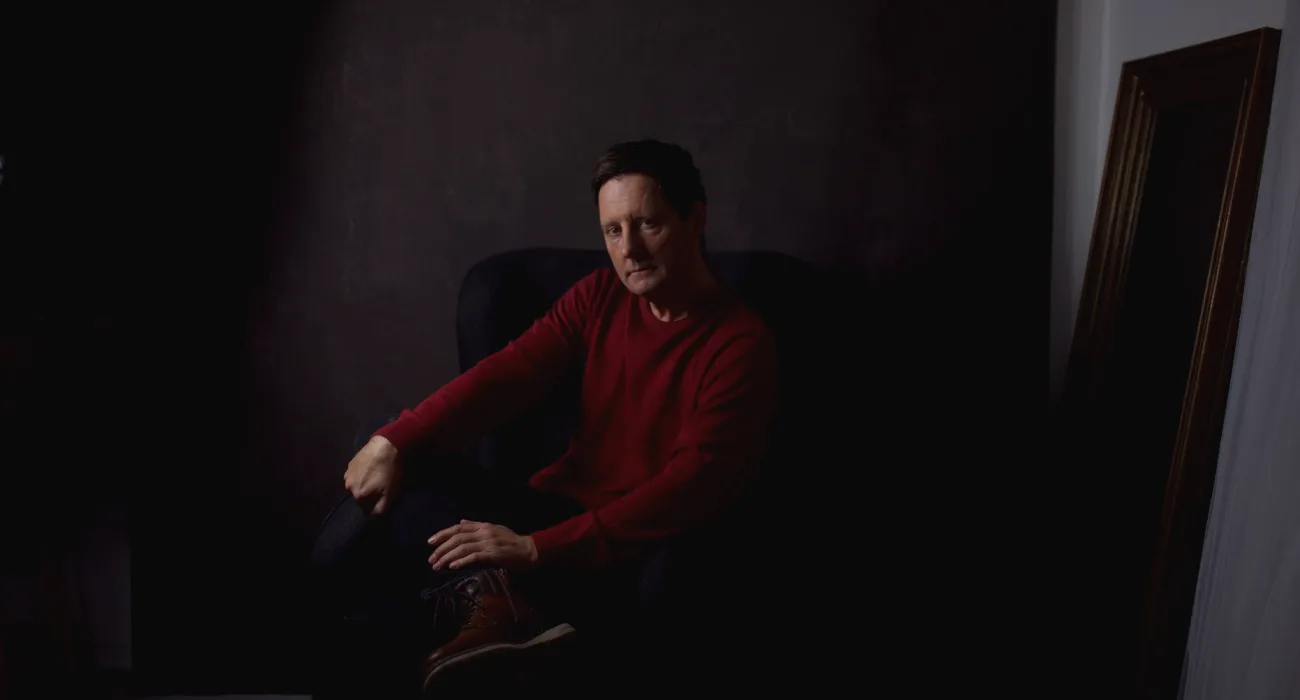
For a standard news interview, frame from the chest up with a little headroom and leave space on the side the guest is looking towards. For a portrait-style piece, move in slightly closer and let the background fall soft and dark, which suits the season.
Place the guest well away from the back wall. Distance gives depth, stops shadows landing on the wall behind the head, and makes the separation light far easier to control.
Sound and comfort in a cold building
Heating systems come on for the first time in autumn, and they bring their own noise: ticking pipes, fans cycling on and off, the hum of a warm-up. Listen in the empty room before booking the slot, and switch off what you can for the length of the recording. A guest who has just walked in from the cold will also speak more stiffly if the room is chilly.
Offer a few minutes and a warm drink before the camera rolls. Dry throats and shivering show up on screen as clipped, nervous delivery. A short, calm chat about nothing in particular lets the guest settle and lets the operator confirm levels.
Record ten seconds of room tone at the end of every session. The editor will thank you when a cut needs a clean patch of ambient sound to bridge it.
- Listen for heating noise before the session
- Warm the room and offer water or tea
- Record room tone at the end of each interview
Planning the season's interviews as a set
If your programme will run several studio interviews over the coming months, record the lighting positions, camera height, lens choice and chair placement on a single sheet. Photograph the setup from behind the camera. A guest booked on short notice in December should look as if they sat in the same room as one in October.
Allow a few minutes more per slot than you think you need, because early dark makes people late and rushed, and rushed guests are harder to light and to hear. A relaxed start saves far more than it costs.
Finally, agree with the editor what the finished file needs: aspect ratio, caption style, lower-third position. Settling these before recording means the interview is framed with the graphic space in mind, not repaired afterwards.
What to hand the editor with each interview
A clean handover shortens the path to air. Label each file with the guest, topic and take number, and flag the best answers with timecode notes as the interview happens. A producer who writes down the moment a guest gives the line that matters saves an hour of scrubbing through footage later.
Tell the editor about anything unusual: a lamp that flickered, a phone that rang, a moment the guest asked to repeat. Small warnings prevent surprises in the cut.
Where captions are needed, supply the correct spelling of names and titles with the files. Names are the detail most often wrong in a rushed package, and the one viewers are quickest to spot.
The darker months reward preparation more than equipment. Cover the windows, fix your light, think about what guests wear and how they feel in a cold building, and keep a sheet that lets you repeat the look all season. Do that, and studio interviews will cut together cleanly, read as natural on screen and reach air without repair work in the edit.